
Checkmate in the South China Sea
- Victoria

- Jul 25, 2020
- 4 min read
Counting days after several Australian warships had reported having encountered warship units of the Chinese navy while sailing across the South China Sea and in within legally acceptable proximity of the contested islands in the region, the Permanent Mission of the Commonwealth of Australia to the United Nations submitted a note with the Secretary-General of the United Nations marking a shift away from its traditionally docile attitude towards its neighbouring sovereign.
The declaration reads that Australia refuses to recognise China’s territorial claims in the South China Sea on grounds of their inconsistency with the 1982 United Nations Convention on the Law of the Sea (UNCLOS), namely the Chinese claims to ‘historic rights’ or ‘maritime rights and interests’ as established in the ‘long course of historical practice’. On a reading of relevant articles in the Convention, namely, Article 7(1)[1] and Article 47(1)[2], the Australian Government denies China’s claims of outright sovereignty in the disputed territories resulting by drawing a straight baseline that connects with the outermost the insular formation, thereby granting China rights over internal waters, territorial sea, exclusive economic zone and continental shelf.
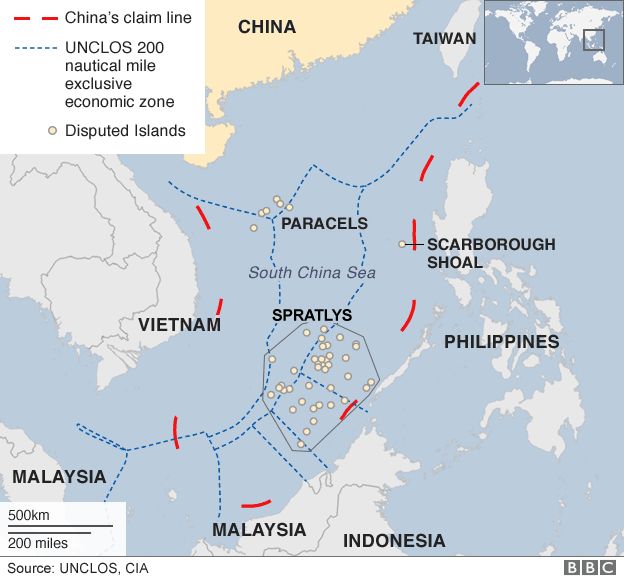
It is also submitted that China cannot claim over maritime zones generated by the artificial transformation of the seabed. This is provided for in Article 60(8) which states that artificial islands do not possess the status of islands and do not have territorial waters of their own, thus serving no legitimate purpose for the delimitation of the territorial sea, the exclusive economic zone nor the continental shelf. Additionally, China’s sovereignty claims over the Paracel Islands and the Spratly Islands along with their statement of wide recognition within the international community are unaccepted by Australia.
The note closed by warning against China’s allegation of the non-binding statement of the Arbitral Award, as per Article 296 and Article 11 of Annex VII of UNCLOS the Tribunal’s decision is final and binding on both parties to the dispute. In these regards, the Australian executive made an encouraging appeal to all parties involved in the South China Sea dispute to ensure peaceful clarification of their maritime claims within the legal for a provided for by the UN mechanism and law, namely the UNCLOS provisions.

An Amicable Relationship Gone Sour
The South China Sea is an area of heightened geopolitical signification and an ever more important and utilised avenue for the conducting of commercial activity in a globalised world economy. Its waters have been exploited for commercial merchant shipping of goods and commodities, and its seabed hosts vast amounts of natural resources, namely oil and gas reserves, while its biodiversity provides for a rich source of fish and seafood.
Surrounded by China, the Philippines, Vietnam and Malaysia, there is a group of islands - and associated reefs, shoals and banks - over which China’s claims of sovereignty seats odds with those evoked by its neighbours. In the years following the World War II the South China Sea was not among the hot topic of the global geopolitical agenda, yet that changed nearing the 1970s once it was ascertained that major oil reserves were to lay in the seabed below its waters.
Unlike the nature of its disputes with Japan, Vietnam, Malaysia, and other countries in the region that have been voicing overlapping sovereignty claims in the South China Sea, the emerging Australian malaise and discontent with its neighbour’s behaviour is economically, rather than politically motivated, as well as it averred aspiration for a ‘rule-based’ order in the Indo-Pacific region. In line with its strategic interest in maintaining amicable relations with what has been its largest trade partner for decades, Australia has been generally supportive of China’s legitimate interest in the region.
Traditionally, Australia’s strategy of ‘dissuasion’, namely working with stakeholders in the region in its attempts to warn China over the disadvantage of unilateral actions and persuading them to acknowledge the benefits of the exiting US-led regional order, has been put to test throughout the years; namely whenever China’s moves were seen as outside the scope of what Australia considered to be an exercise of legitimate interests, such its announcement in 2013 about its intention to establish the so-called East China Sea Air Defence Identification Zone (ADIZ). The most recent encounter between the Australian and Chinese representatives at sea was seen among the Australian pollical elite as an affront to the principle of international law– freedom of navigation – which they are committed to upholding for reasons of national interest and international trade. Effectively, this was the impetus behind Australia’s submission to the UN Secretary-General.
The Seeds of a Trade War in the Indo-Pacific?
Upon similar naval encounters in the past, Australia’s response was diplomatically more moderate, both parties have stated that as long as their presence in the South China Sea was in accord with international law neither had further objections. However, at present, it seems that Australia has taken a turn from not taking sides – at least publicly - in the ongoing territorial disputes and onto taking a stronger stance regarding China’s claims, thus aligning its discourse more in tune with it its American allies. Nonetheless, in its efforts to upkeep its positive relationship with the United States the Australian executive should avoid turning a blind eye onto the domestic business community and their voiced concerns over the negative impact on trade relations with the Chinese and the potential hit that exports to China could take as a result.
Whether this seeming aggravation of the Chinese-Australian diplomatic relations would lead towards a worsening of their economic ties is a matter of speculation. Yet, what seems to be a statement with which most would agree is that amid a slowdown of the international economy and commerce on the back of the now too long-lasting US-China trade war and the global COVID-19 pandemic, another story of yet another souring of economic relations between two of the biggest world economies is something better to be avoided than stirred.
[1] provides that straight baselines may be employed ‘ [i]n localities where the coastline is deeply indented and cut into, or if there is a fringe of islands along the coast in its immediate vicinity’ [2] limits the use of archipelagic straight baselines to archipelagic States, as defined in Article 46.


Comments